


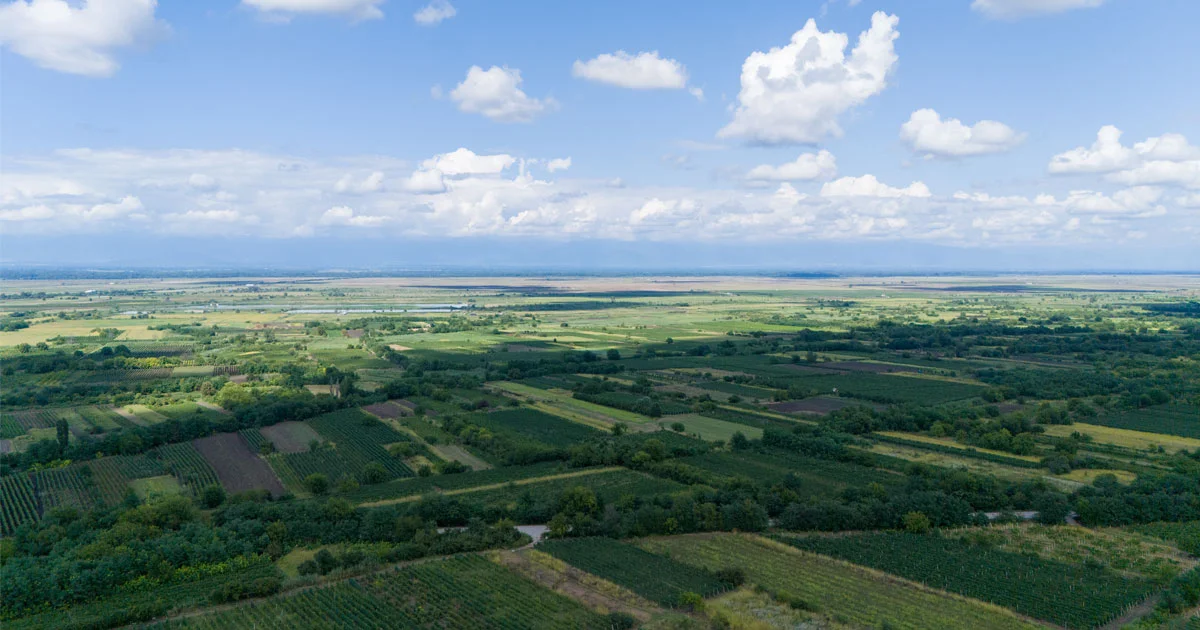
The Alazani Valley (also known as the Alazani Plain) is an intermontane accumulation plain in eastern Georgia, situated between the Kakheti Greater Caucasus, the Gombori Ridge, and the Gare Kakheti Plateau.
At an altitude of 200–470 meters above sea level, the territory is formed of young Quaternary sediments and slopes toward the southeast. The Alazani River cuts across the entire length of the plain (160 km), while its width ranges from 5 to 37 kilometers.
Climate and Nature
Eastern Transcaucasia is distinguished by a particularly mild and soft climate. It features a moderately humid climate with moderately cold winters and hot summers. Annual precipitation ranges from 700–1000 mm (maximum in May, minimum in January), and hail is frequent.
Nowhere else in eastern Transcaucasia is there such a mild climate. Hence the richness of lowland vegetation unusual for other parts of eastern Transcaucasia, such as the presence of forests away from rivers at an altitude of just 300–500 meters above sea level. Part of the plain is covered by forests (oak, ash, maple, poplar), while a large portion is occupied by secondary forest-steppes and steppes.
Settlements and Viticulture
The Alazani Valley is rich in natural resources and is one of the most densely populated regions of Georgia. Major settlements (Telavi, Gurjaani, Kvareli, Lagodekhi, Akhmeta, Sighnaghi, Tsnori, Shilda, Napareuli, Kardenakhli, and others) are primarily located along the edges of the plain—at the foot of the Kakheti Caucasus and the Gombori Ridge.
According to natural conditions, the valley is divided into two parts:
Right Bank (Primkhari / For-side)
Left Bank (Gaghmamkhari / Trans-side)
Kakheti is Georgia's main winemaking region, producing approximately 70% of the country's wine. The unique Georgian winemaking method using the kvevri is inscribed on the UNESCO Intangible Cultural Heritage list. Of the two classical technologies existing in the world (European and Kakhetian), both have been used in Georgia since ancient times.
Archaeological and Historical Heritage
The Golden Lion of Tsnori: Discovered in a monumental kurgan excavated near the village of Tsnori in the Alazani Valley, this gold lion statue dates back to the second half of the 3rd millennium BC (currently depicted on Georgian paper currency/coins). An early depiction of a lion from this period has no analogues anywhere in the world.
The Homeland of Vine and Bread: Georgia is an ancient cradle for the domestication of cereal crops, where 14 natural wheat species are registered. Unique wheat varieties that remain close to wild species through evolution have survived to this day only in Georgia. Bread and wine held a sacred, ritual significance in Georgian culture, which led to diverse ethnographic traditions and methods (such as tonis kultura/tonis bread culture, ritual breads, etc.).